

The Competence Performance
What school taught us to perform, and what actually moves the needle

When I landed my first job out of graduate school, I had two overwhelming thoughts: 1/ I really hit the jackpot with this well-paid (for a nonprofit) gig and a boss I liked a lot, and 2/ I am ridiculously unqualified for this role.
After leaving journalism to get a Master’s in public policy, I had gotten an internship at the NYC Mayor’s Office under Bloomberg thanks to a guy I met at a wedding who ended up hiring me. (Don’t ever let anyone tell you that luck doesn’t play a massive role in success – these anecdotes are a dime a dozen, but they feel rare because people like to sand them away as they refine their ‘how-I-got-here’ stories.)
Our project fighting to achieve comprehensive immigration reform had generated enough success that after the Bloomberg administration ended, we were offered the chance to launch a nonprofit with financial, legal, accounting and HR support, not to mention excellent office space. It was an unbelievable opportunity – the only problem was I had no idea how to build or run a nonprofit. Luckily, I didn’t let that stop me. I was offered the role of Chief of Staff, despite the fact that we had no staff. I took the job.
My boss, J, was typically the smartest guy in every room. He was book smart, but he also thought about the politics (of the office) and the Politics (of DC) just as much as he thought about the substance, which – for better or worse – is what’s necessary to have some real impact. And he moved fast. He talked fast, thought fast and reveled in trying to be 3 moves ahead on the chess board all the time. On our first trip together to DC, he planned so many meetings back to back he forgot to schedule time for us to even stop at a vending machine, much less eat lunch. By the end of that day, I was starving and intimidated, the gaps in my knowledge so glaring I was positive that everyone knew what a fraud I was.
I knew I needed to step up. So I tried to be just like him. I tried to learn everything about immigration policy so I could spout facts in meetings (who doesn’t love facts in meetings!?). I tried to brainstorm ideas on the spot even though I had no helpful experience to draw on. I tried to be the second smartest person in the room (I’m not an idiot – I wasn’t trying to outshine him, I was trying to emulate him). And it all fell flat. I could feel myself inadvertently throwing sand in the gears just as we were trying to launch this organization.
You know when one person decides they’re done with a relationship but they haven’t ended it yet? And the other person can feel it but doesn’t want to admit it, so they keep trying more and more desperately to hang on even though everyone can see it’s just making things worse? It felt like that. (Minus the romance). I didn’t realize it but I was performing the wrong skill entirely, and I was afraid I was about to get dumped.
We love to look competent at work
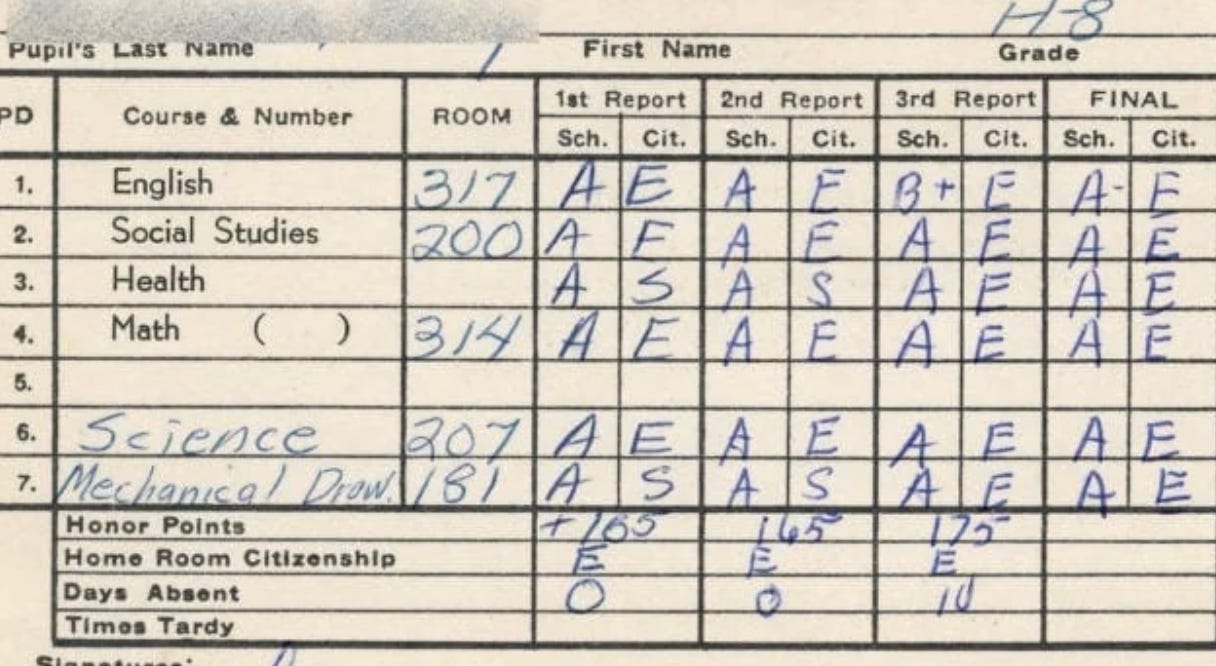
We humans have a long history of trying to show competence above all in professional settings. And it makes sense because from a young age, we’re taught to perform it constantly. We’re measured in grades, SAT scores and resumes so of course we think that “hard” skills equals strength at work. If you’re the kind of person who manages to be well-liked and respected in school, you’re rewarded with a lot of friends and a good reputation. But none of that has anything to do with whether or not you get an A in calculus. And As are what carry forward to the next big hurdle: getting into college.
From there, it’s the same story: soft skills dictate your experience but the grading system overindexes on the hard skills. Ask a group of people how many of them took economics 101 versus the art of communicating effectively (a class that I just made up but hope actually exists) and you’ll see what I’m talking about.
The problem is that this flavor of optimization doesn’t account for human nature. It’s great if you know how to read a P&L, but if you don’t know how to explain it to people in a way that they understand and trust, and then formulate a strategy off of it that your team actually follows, you’re going to be limited in your ability to get things done.
It turns out it’s really hard to be an a**hole who is also considered a good leader – the chances are about 1 in 2,000. Despite the disproportionate number of stories we hear about the toxic geniuses of the world, they are actually much rarer than their fundamentally decent counterparts.
As I wrote about last week, we judge each other much more on our warmth than on our competence, and that extends to leaders.
But it’s not just about likeability – there are real, downstream outcomes that improve too. It’s economically beneficial to be warm towards other people, in part because it makes you more trustworthy and trust is what makes people invest.
Beyond reputation and money, warmth also impacts health. Studies show that when surgeons treat patients and their families with decency, care and respect, the on-the-table outcomes are better. In other words, not being an a**hole before surgery means that the surgery itself is actually more likely to be successful. And yet, when the psychologist Susan McDaniel, who also happens to be my mom, did an analysis of surgeon behavior, she found it was, um, sub-par. Among other things, she found that they rarely use empathy when delivering bad news, criticize other physicians to patients and talk about themselves in ways that are both irrelevant and unhelpful. Building on those findings, she created a coaching program where psychologists teach surgeons how to be better at their jobs by being better, warmer communicators with their patients. I’m biased, but this seems like the type of leadership training we need more of across industries.
In contrast, one of the best sources on the topic of warmth in leadership, Connect, Then Lead, has a ton of excellent research pushing back on our culturally created instinct that performing competence is the answer at work. But it also has an entire section giving instructions on how to be warm. Their suggestions aren’t necessarily wrong but if you are reading the Harvard Business Review to learn how to be a decent human being, especially if you’re only doing it in service of raising your own influence, I don’t think you’re going to get very far. I’m imagining a young Mark Zuckerberg being coached to “lean forward” “make eye contact” and “avoid appearing rigid or tense”. We all know how well that worked.
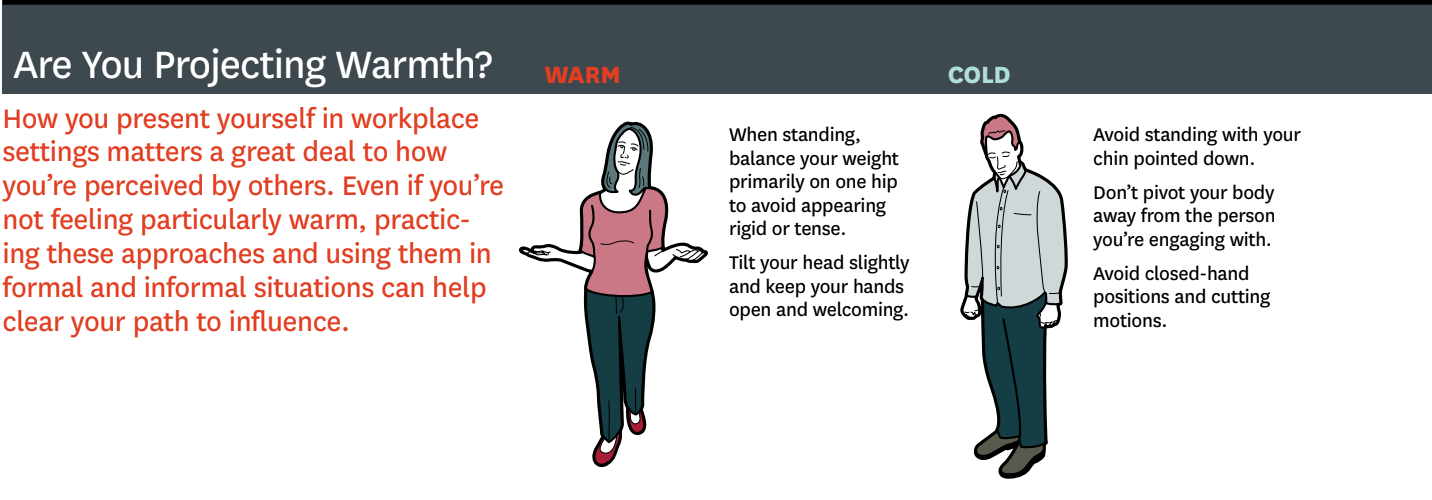
Depending on some combination of your natural disposition, your parents, the way your first love treated you, how good your therapist is and/or your high school experience, you may or may not be particularly good at “warmth.” But it’s these kinds of ‘how-tos’ in one of the top business journals that make me think maybe we’ve lost the plot. Call me crazy but I think it’s less about not standing with your chin pointed down and more about generally learning to communicate well and treat others with respect. This is a good rule of thumb for just being in the world and maybe the problem is that we treat work as a separate universe where we compartmentalize our humanity in favor of looking competent and hope we get promoted.
Back to my rocky start at the new job
Finally, I phoned a friend. The bride of the wedding where I had originally met J was close to him and I needed someone who knew both of us to tell me what I was doing wrong. Over dinner, she listened as I relayed this tale of me blowing the best career opportunity I’d ever had. And then she gave me some of the best advice I’ve ever received. “Your superpower,” she said, “is that you are an excellent friend. You two are trying to start an organization. He doesn’t need you to be him, he needs to feel like someone has his back, like he’s supported and like you’re in this together. Do that, and the rest will come.”
This might all sound obvious, but it was a lightbulb moment for me. She wasn’t telling me to just ‘be myself’, she was telling me to resist the urge to perform competence and instead focus on what I could reliably provide right then – emotional and social support and intelligence. And she reminded me that those skills are not only useful, but essential at work.
I didn’t know how to build a nonprofit (yet), I wasn’t an immigration policy expert (yet) and I hadn’t done advocacy work (yet). I needed to learn those things eventually, sure. But be a friend? A support? An emotional center at the start of something new? Those are things I knew how to do now. Those are things I could nail. And those could be my initial contributions to this work.
The next day, I changed my approach.
When things got stressful, I made jokes. I gave support. I ideated on how to collaborate best with our partners because I wasn’t yet ready to ideate on the policy itself. I gave some good pep talks. It’s not necessary to be genuine friends with all colleagues, but if you’re starting an organization together it really really helps. So I focused on solidifying our partnership, and things changed almost immediately. We became a team and the rest flowed from there.
Often, the skills that matter most at work aren’t the ones we’re measured against. Which means that many of us are walking around significantly underestimating our own professional value – and performing the wrong skill. Our culture gives us the tools and feedback to master the hard skills. But that’s – at most – half of the equation. The skills that actually got you where you are – the same ones that will take you where you need to go – were probably never on your resume. That doesn’t make them any less powerful.
There is a lot of wisdom here that is so rarely discussed in traditional leadership books.
You mention warmth. Real, human, authentic support and connection. Absolutely.
You also hint at a crucial idea - the team as a collection of DIFFERENT people each bringing something unique and important to the mix.
Tom DeMarco and Tim Lister spoke to this idea in their seminal work PeopleWare. They talk about a high-functioning team where a woman played the role of "glue" that bound that team together. Made everyone better. Management didn't understand what she did and nearly fired her because that contribution was hard to measure.
Two other ideas for leadership that are vastly underrated:
Leader as coach
Leader as servant
Neither is about authority. They are about supporting the team in ways that help it achieve its potential. And grow in that. I wrote about the servant idea here: https://smmoulder.substack.com/p/he-called-me-a-servant?r=2xahz&utm_campaign=post-expanded-share&utm_medium=post%20viewer