

TextGen
The skill we forgot to pass down

About 15 years ago, I went to a birthday party at a bar in Nolita called Firefly.* Dark and musty, it was filled with mid-20-somethings like myself ordering vodka sodas with a splash of cranberry and buzzing on that kind of nightlife energy only accessible in New York. I was nervous because I knew I would run into a close friend who ghosted me. So I’d invited a friend to come along for reinforcement and she brought a friend who brought a friend – a guy in a black shirt and those “I’m smart but also stylish” kind of glasses. Gradually, all the friends and friends-of-friends arrived, and the party started to hum.

I had just gotten into graduate school so I knew that I would be leaving my stressful job and New York in five short months. With that knowledge came the luxurious mindset of having a plan – the one where everything feels low stakes because you already know what the next chapter holds. Secure in knowing where my next station would be, there was nothing left to do but enjoy the ride.
So when that guy with the glasses offered to buy me a drink, I said sure.
And when he asked to take me out to dinner the next week, I thought why not? As every girl who has ever lived in New York knows, the chances the guy actually follows up are slim, but with only a few months left in the city, I figured it didn’t hurt to say yes.
And then a few days later he called – yes, called – and I panicked. Not at the fact that it was him, but rather that he apparently wanted to talk live. It was 2011! Hadn’t we moved beyond that except in cases of emergency or calls with grandparents?! I grabbed my roommate and we both stared at the screen watching it ring like the phone might explode at any moment. Maybe you should pick it up…?, she suggested with audible hesitation, both of us equal parts shocked and suspicious. He left a message. He wanted to know if I liked sushi. The gall of this guy.
In the fifteen years since, I and everyone else I know has pretty much moved entirely away from spontaneous phone calls.
Texting is king but like all digitization of our social lives, it does that neat trick where it leaves us technically more in touch but emotionally less connected all at the same time.
Texting opened up a world of convenience when it came to, say, planning a coffee. But it’s one more way that we get to be just a little less vulnerable with each other – and that has a cost. Studies show the obvious, which is that phone calls produce much stronger feelings of connection than texting. But they also show that phone calls don’t produce more feelings of awkwardness – and that’s where we get it wrong.
As I’ve written about before, we are constantly underestimating each other. That extends to texting – we often text not for the connection, but to avoid the discomfort of a call. Even though the reality is, the call rarely ends up being awkward. The problem is that our collective misperception means that we almost always resort to text.
In fact, voice connections are uniquely resonant. One study found that voice-only communication is actually the best way to understand one another, holistically and emotionally – even better than when visual cues (like faces) are involved. In other words, adding someone’s face actually reduces emotional understanding.
The theory is that when faces are involved, people can perform. Imagine getting fired from a job – your face might project calm, stoic resignation. But you’ll probably work to say as little as possible because your voice – shaky, soft and strained – betrays your true feelings. There’s something about a voice-only conversation that strips away the ability to perform. Sometimes, the truth is in what you hear, not what you see.
The sociologist Rich Ling has written about the evolution of technology to allow for better coordination. It took us 200 years to fully adopt clock time, which meant we had a lot of space for trial and error around norms, usage, and spiritual and cultural arguments for how this technology might help or hurt us. In contrast, texting took hold over about 20 years – the first text was sent in 1992 and it was off to the races from there. Before we had the chance to consider what we were losing in this evolution, adoption was so high that it became (and remains) socially prohibitive not to text.
Which is how we ended up here:
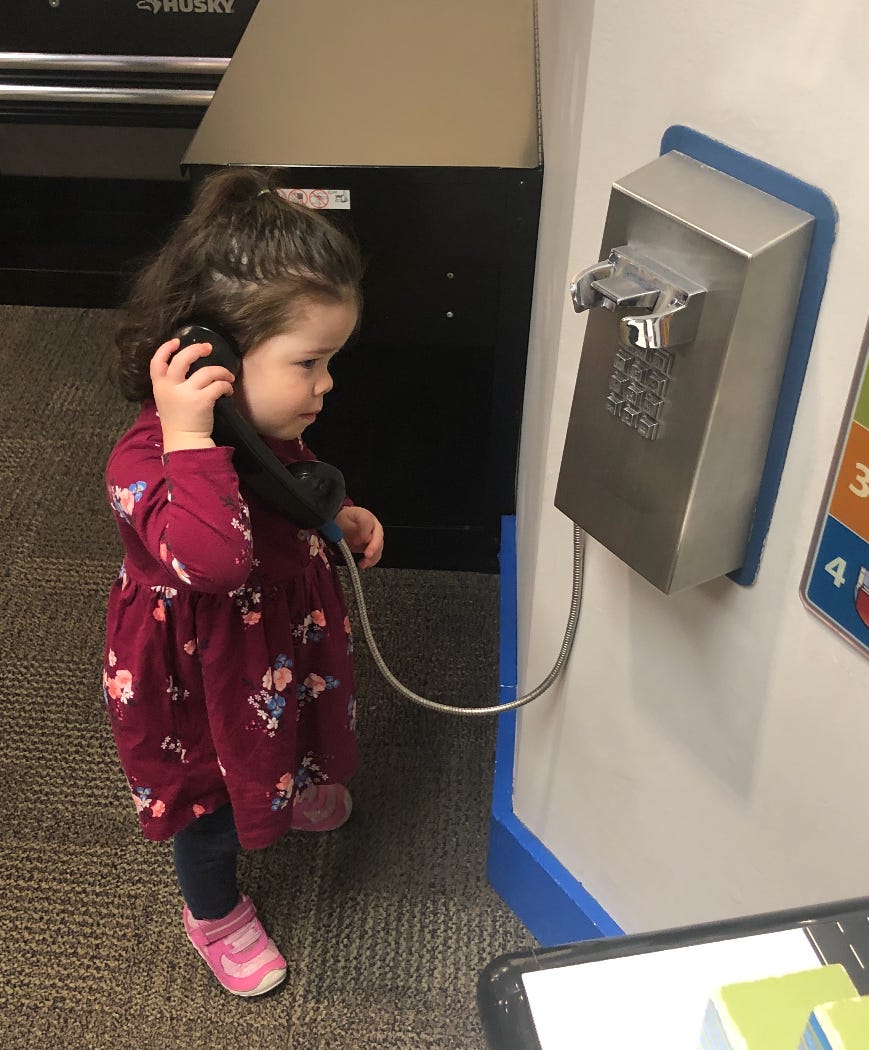
WHO IS THIS?!, yells my daughter into her Tin Can, an ingenious gadget clearly invented by a millennial parent who read The Anxious Generation. It’s like a hybrid between a walkie-talkie and a landline that lets my daughter talk with anyone else who has one, but it looks like the phones of yore (no screen, plugs into the wall, real buttons). And let me tell you, I have never felt older than when I have watched my kid talk on this thing because she has zero phone etiquette at all.
Despite being a generally well-mannered eight-year-old, when she’s on it she speaks in a voice I’ll call ALL CAPS. As if talking to someone who has recently betrayed her, she demands to know who it is and why they could possibly be calling. There are no niceties or small talk, nor a friendly wind-down at the end. When the necessary information has been exchanged, she slams down the phone with a force totally disproportionate to the three minutes of playdate planning she just did. CASE CLOSED, I imagine her muttering to herself because I swear that’s the vibe she gives off.
After asking around, I learned that all of the kids are like this. After a lifetime of watching their parents text instead of talk, they know how to be on a zoom but an old fashioned call? Not so much.
I am not anti-texting. But it has occurred to me that even this seemingly benign technological evolution has left us a little more lost from one another than we were before. It’s less about the addition of texting to our lives – sometimes, it really does make sense. But in too many cases, it has displaced the phone calls that were part of the connection infrastructure we didn’t know we needed until it was gone.
What does it look like to raise a generation who never learns the skills that the phone teaches?
What does it look like when the most resonant and vulnerable way of communicating is hardly even in the repertoire, much less the default? We’re about to find out.
Ling’s theory is that texting has brought us close to our inner circle and further from everyone else. I think that’s because it supplements the strong ties – your inner circle will be people you see, call or have history or other foundational infrastructure to sustain. Texting with them is an additional channel but it’s not responsible for fortifying the relationship. But with weak ties, it’s different. We think texting sustains them, but if nothing else is in place, any depth that relationship had can erode quickly until it’s not really a connection at all. It’s why you can have a phone conversation with someone you haven’t talked to in months and feel the friendship rekindling immediately. But a flurry of text exchanges can only take you so far.
Somewhere along the way, we loosened what turns out to be one of the most important threads in the social fabric. And we didn’t even realize it because in the moment, it feels like convenience, like efficiency. It feels like a win. Until one day you realize that while you text with someone pretty regularly, you don’t actually know them anymore.
Slowly, I’m teaching my daughter the lost art of the phone. I’ve told her that I spent hours talking on the phone when I was young, building the foundation for friendships that have lasted for decades. And I told her that the best guy I ever dated thought to call after we met, and that even though I didn’t pick up at first, I’m so glad I called him back. Because many phone calls later, we got married. Without that phone call, she wouldn’t be here.
I’m back to more phone calls with girlfriends. And recently have switched to voice memos rather than texts and the response is wonderful! I’m told how much they love hearing my voice and it’s prompted a few to send me voice memos in return. Can’t deny the power from hearing your pals voice rather than words texted. Thanks for the writing!
Such a nice article.
I agree with you when you said we avoid calls because of the discomfort that comes with it. I've seen that personally.
I don't like texting but I call when it is necessary.