

Dry January
A month without the news

Late last year, I decided that I would take the month of January off from the news. After 2025, I just felt like I needed a break (and no, I did not also take the month off from alcohol – that would be asking too much). Anyways, the first thing I noticed was that once I made this decision (December 15th-ish), I started to feel anxious, jittery and honestly a little nervous. Like a person about to go on a diet, I used my last days to consume as much junk food as I possibly could, voraciously taking in all kinds of news and gorging myself in anticipation of the month ahead. And then, on January 1st, I quit.
To be clear, I didn’t shut down conversations about the news, refuse to acknowledge the events of the world or willfully ignore what was happening around me. For me, this meant no mornings scrolling through the NYT and the FT, no stories about any current events, no deep dive analyses on the news of the world. It meant no thought pieces on what comes after Trump, no hot takes on our scattered foreign policy and definitely no videos of any kind.
But I don’t live under a rock, so the big stuff – Venezuela, Greenland and the devastating murders of Renee Good and Alex Pretti in Minneapolis hit my radar. This turned out to be lesson #1 which is that it’s not really possible to take a true break from the news. That is an obvious comment on the world we live in, but I actually found it really liberating. Because during my month off, any worries that I would somehow miss something big were disproven. I run in circles of deeply informed (if anxious) citizens. So I quickly learned that if there is anything big to know, someone will tell me. And there was surprising relief in knowing that taking a break from the news didn’t make me ignorant.
I took a break because reading the news was making me feel stressed, panicky and helpless (perhaps you can relate?). But I also took it because of something I’d noticed in myself and the people around me, especially here in DC: we had started to equate being informed with being a good citizen. Like the sheer volume of information we consumed was itself a form of participation.
I felt pressure—in conversations, in my own head—not just to know what was happening, but to have opinions on all of it. And when everyone feels pressure to have an opinion regardless of how much you actually know, conversations can get…unproductive. But sometimes, it feels like tracking every development is a civic duty, like staying informed was the same as being engaged.
When I told people about it the reactions were split. Some people applauded me but many others judged. Those people said something to the effect of ‘it is our responsibility, especially right now, to be informed.’ And on instinct, I tend to agree. But what is ‘informed’? Is it knowing every twist and turn of the latest Trump antics? Is it staying aware of what’s happening in your own community? Is it gathering the information you need to take action where you can?
Can you be an engaged citizen without consuming news constantly?
The Doom Loop: Why the news makes us feel terrible
To understand why this question even needs asking, it helps to know why the news makes us want to take a break from it in the first place. One piece is the facts (obviously). But another piece is your brain because it fuels a vicious cycle in all of us that looks something like this:
1/ You see a mix of stories – some hopeful, some horrific.
2/ You pay more attention to the negative (this is called negativity bias).
3/ Your brain encodes those stories more deeply, giving them more weight than is logical (this is called the availability heuristic).
4/ You go looking for confirmation that the terrible trend you just heard about is indeed true, and you find it (this is called confirmation bias).
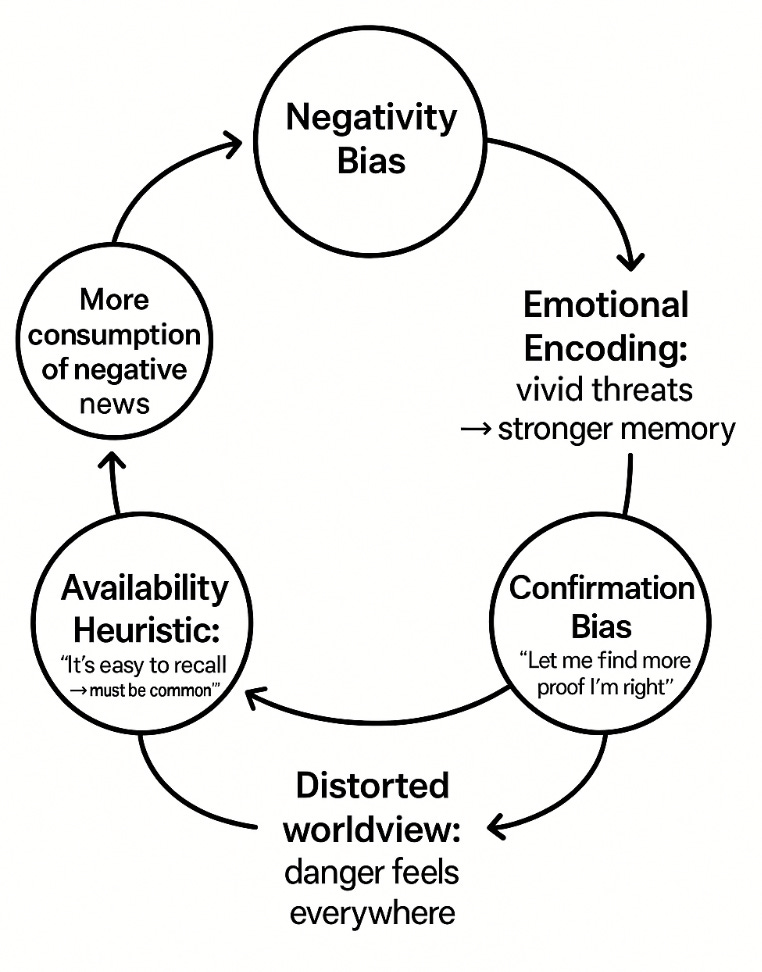
This is the Doom Loop. Our brains aren’t built for nuance, they’re built for survival. Which means they are not neutral processors of information. Our biases and heuristics – traits that have literally saved us from extinction are now, ironically, hurting us as a society.
The business of doom
The Doom Loop isn’t just a cognitive trap — it’s an economic engine. Media companies, platforms, and influencers aren’t accidentally feeding you fear. They’re optimizing for it because fear grabs attention, and attention is money.
A Harvard Nieman Lab study tested how language affects clicks. Add a negative word to your headline — “harm,” “heartbroken,” “ugly,” “troubling,” “angry” — and you get 2.3% more clicks. Add a positive one — “loved,” “benefit,” “pretty,” “kind” — and clicks go down. When you have ads to serve, that difference is worth billions of dollars.
Not surprisingly, an analysis of 23 million headlines from 47 U.S. news outlets between 2000-2019 showed a sharp, sustained shift: news got way more negative. Not more accurate or more balanced. Just more emotionally manipulative.
So the system is rigged – biologically and economically – to distort your worldview. It doesn’t matter if progress is real. Your brain is too busy scanning for threats. And today’s media ecosystem is happy to supply them. Which is why I needed a break in the first place.
Ok – back to my question: Can you be an engaged citizen without consuming news constantly?
After a month off the news, here’s my answer: Yes. And I was a better one.
In January, my day to day improved. I wasn’t sucked into conversations about ultimately irrelevant but momentarily nerve-wracking political revelations. I didn’t experience the emotional swings that can come with refreshing the news cycle day after day. I was more present in my immediate surroundings – sometimes when I read the news, my head is somewhere else entirely (like Greenland) while my body is in DC. This month, they were in the same place.
But the bigger surprise was this: taking a month off from the news didn’t change the fundamentals at all. I was and am still as sad, angry, scared, hopeful and determinedly optimistic as I was before. I still took action regularly, where I thought I could have impact. I was still, without question, an engaged citizen.
In fact, without the deluge of news, I think I was a more engaged citizen.
Because I was a little bit more present to the things I could control and a little bit more optimistic about what’s possible. I found my thoughts were actually clearer. And my conversations were more real and less doom spiral.
This was – and is – disorienting because I now see that I have always assumed that being informed and being engaged were the same thing. I thought tracking every development was itself a form of civic participation. But I was wrong.
It took me a while to understand why I’d conflated consumption with engagement. Then I read Amanda Ripley’s’s analysis and it clicked. “In a dysfunctional family (or country), there’s often one person who creates all the drama,” she says. “Family therapists call this the “identified patient.” …This person gets a lot of attention, understandably. But their antics tend to distract everyone from other, deeper problems in the family.
Donald Trump, she says, is our identified patient. She points out that in the past six months, the New York Times has named the identified patient in a headline 4,520 times – roughly 25 Trump headlines a day. (During the equivalent period under Biden, the newspaper mentioned him in a headline just nine times a day.). Some of this is warranted, of course. He is the leader of the free world and his decisions and movements impact everyone.
But we – concerned citizens, the media, our businesses, our institutions – have become totally fixated on the identified patient. And it’s distracting us from the real work. Because obsessively tracking his every move feels like engagement, it feels like we’re doing something that we have to be doing. But we’re not and we don’t.
Because here’s the thing: he is terminal.
No protest, ruling, or thought piece will heal him and it is a waste of our time and resources to try. He is exploiting pain and divisions that already exist and that is where we have to focus. We as a nation are sick too – but we have to heal ourselves from the inside. That’s the real work.
The best part about a month off from the news was that it felt like a month off from Trump (ok, not completely off, but he was much less present in my thoughts). But whether it’s Trump or something else, our brains and our media will fixate on fear if we let them.
I don’t have a formula for healthier news consumption – it will take me longer than a month to figure that out. But now I’m thinking differently about what the news is actually for and how that might change what I consume and what I don’t.
I want to consume news if:
It allows me to bear witness to history. Watching the clips of Renee Good and Alex Pretti get murdered in the streets of Minneapolis was about bearing witness to something uniquely consequential and devastating happening in our country. Journalism, as they say, is the first draft of history. In order to start living a better next chapter, we have to understand, feel and witness what’s happening now. And yet, bearing witness to everything is impossible. There is a difference between witnessing history and carrying those lessons forward, and wallowing in sadness or outrage. Understanding this difference is key.
It lets me gain the information I need to act. From protesting in the streets to answering questions from my children, I need the news to help guide my own decisions and actions. Because agency is the antidote to fear, and agency starts with good information. Knowing what ICE is doing helps me figure out how to help my own community. Watching a Trump soundbite about it doesn’t.
It helps me understand the context I’m living in. We are all suffering from a deep misunderstanding of one another. Thoughtful, nuanced reporting has the capacity to show us to one another in ways we might otherwise not see. Right after the 2024 election, I listened to interviews with first time Trump voters who talked about the way they felt replaceable in American life. I couldn’t relate, but after listening, I could understand. That kind of journalism is worth consuming.
We cannot bury our heads in the sand. But neither can we stand directly in front of the firehose and expect to see clearly.
We are offered a steady diet of heavily processed news – the kind with packaging designed to hook us and a bunch of additives thrown in aside from the truth.
Here’s what my month off taught me: being informed is not the same as being engaged. And good citizenship isn’t about knowing the most. It’s about bearing witness to those crucial moments, gathering information that you need to act and better understanding one another.
With that in mind, I’ll be consuming a lot less in 2026.